Getting hurt on the job throws up a lot of questions and one of the first is usually how long after an accident at work can you claim. Understandably, most people do not want to make a decision while they’re still dealing with pain, time off or a stack of medical appointments. But leaving it too long can cost you the right to claim at all. In England and Wales the accident at work claim time limit is generally three years, though a handful of exceptions can change that.
The scale of the problem is bigger than most employees think. The Health and Safety Executive recorded around 680,000 non fatal workplace injuries across Great Britain in 2024/25, roughly 2,070 for every 100,000 workers. Slips, trips and falls made up close to 30% of these with manual handling injuries not far behind at 17%. Chances are, if you’ve been hurt at work, you’re far from alone.
The Accident at Work Time Limit in England and Wales
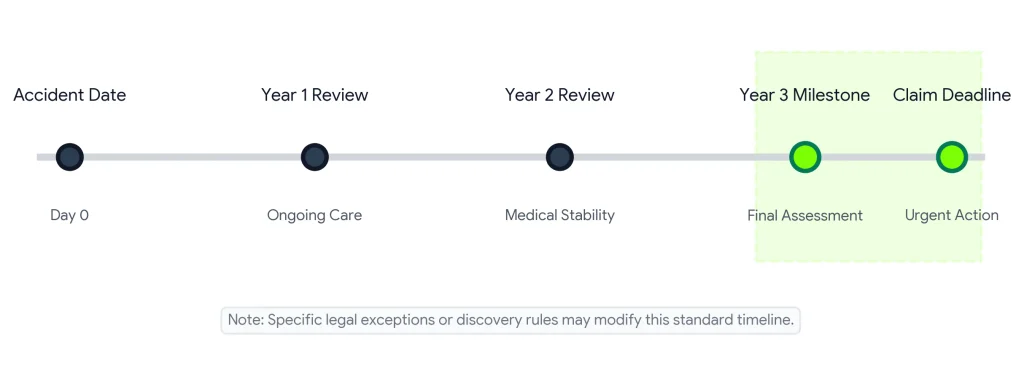
Under the Limitation Act 1980, the standard workplace injury claim time limit is three years from the date of the accident. This covers the majority of cases we see, from a fall on a wet warehouse floor to an injury caused by equipment that was not properly maintained.
There’s one common exception. If the person injured was under 18 at the time the three years does not start until their 18th birthday which effectively gives them until age 21 to bring a claim.
One thing that catches people out: the three year limit is about when court proceedings must be started. Not when the claim has to be finished. Plenty of cases run on for months, sometimes longer after they’ve been formally issued. Especially where the injury is healing and the medical picture is not fully clear yet.
When Does the Three Year Clock Actually Start?
For most claims, the countdown begins on the day of the accident. Simple enough. But the law also allows for something called the date of knowledge, covered under section 14 of the Limitation Act 1980 and this is where things can get less straightforward.
Take industrial deafness or a repetitive strain injury that builds up gradually. In cases like these, someone might not connect their symptoms to their job until years after the exposure started. When that happens, the three years can instead run from the point you first realised or reasonably should have realised, that your condition was linked to your work.
Why You Should not Wait to Start Your Claim
Having three years on paper does not mean you should use all of it. Memories are not reliable forever, colleagues change jobs and CCTV recordings are often overwritten within a matter of weeks. The sooner details are captured, the stronger they tend to be.
We’ve watched this play out directly. A factory worker we recently represented ended up with £60,000 in compensation largely because the evidence was gathered early while everything was still fresh and easy to verify. Starting your claim promptly does not mean rushing to settle. It just means protecting the facts while they’re still there to protect.
Are There Any Exceptions to the Standard Time Limit?
The three year rule covers most cases but a few situations work differently:
- Children under 18: the clock does not start until their 18th birthday
- Mental capacity: if the injured person lacks capacity to manage their own affairs, the time limit is paused, potentially indefinitely
- Fatal accidents at work: dependants usually have three years from the date of death or from when they learned the death was linked to negligence
- Industrial disease: governed by date of knowledge rather than a single fixed date
Courts do hold some discretion under section 33 of the Limitation Act 1980 to let a claim proceed slightly outside the usual window but this is rare and far from guaranteed. Treat it as a safety net, not a plan. Speaking to a solicitor early is always the safer route and our FAQs page covers a few more of the questions we’re regularly asked about claim timescales.
What Should You Do After an Accident at Work?
A handful of practical steps in the days after an accident can make a genuine difference later on:
- Report what happened to your employer and get it logged in the accident book
- See a doctor, even if the injury feels minor to begin with
- Photograph the hazard, your injuries and the general area if you’re able to
- Get the names of any colleagues who saw what happened
- Hold onto payslips, receipts and anything showing lost earnings or treatment costs
- Talk to a personal injury solicitor before accepting any offer from an insurer
Employers are legally required to carry out regular risk assessments, keep equipment in safe working order and give staff proper training and supervision. Where they fall short and someone is injured as a result, a claim is usually possible. Your employer also can not lawfully sack you or treat you unfairly for making one, since they’re required by law to hold insurance that covers exactly this kind of situation.
Speak to JK Lawyers About Your Workplace Injury Claim
We’ve been handling personal injury claims for over 25 years and hold Law Society accreditation in this area so accident at work cases, along with trips, slips and falls and other workplace injuries, are territory we know well. From your first phone call you’ll be speaking to a solicitor rather than a case handler and that same solicitor stays on your case from start to finish. We work on a no win no fee basis so there’s nothing to pay upfront. You can also read more about our approach on our About Us page or browse recent case outcomes on our news page.
If you’re still working out how long after an accident at work you can claim or just want a straight answer about where you stand, request a callback and one of our solicitors will talk it through with you, free of charge and with no obligation.
FAQs
How long after an accident at work can you claim?
Three years from the date of the accident in most cases. If the injured person was under 18 at the time that three year period only starts once they turn 18.
Can I still claim if the accident was partly my fault?
Usually yes. This falls under contributory negligence meaning you can still be compensated even where you share some blame. Though the final amount may be reduced to reflect it. Worth discussing the details with a solicitor rather than assuming either way.
Will I lose my job if I claim against my employer?
You will not. Employers must carry insurance to cover exactly this situation and dismissing or penalising someone for making a genuine claim is not lawful.
How much compensation can I get for an accident at work?
It varies a lot depending on how serious the injury is, whether you’ve lost earnings and any treatment or travel costs involved. Most solicitors will need a medical report before giving you a realistic figure.
What if I did not report the accident at the time?
Not having an accident book entry does not rule out a claim. It just means other evidence such as medical records, witness accounts or photos, tends to carry more weight in building your case.