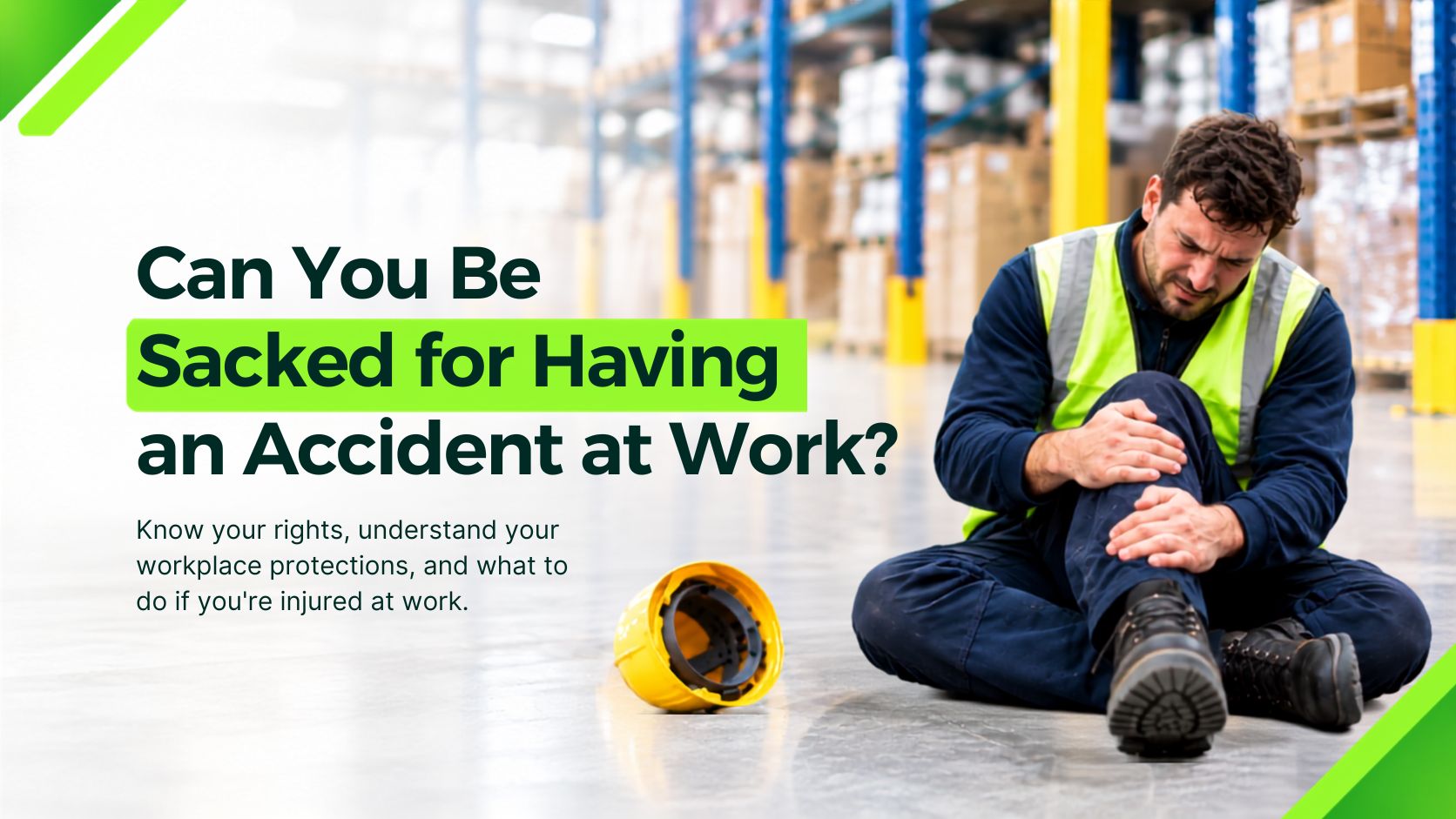
Getting injured on the job can be hard enough without being concerned about your work. Occasionally we get asked, can I be sacked for having an accident at work? The answer is not always simple. What matters is why you were dismissed and how your employer handled the situation.
We explain what UK law has to say about dismissal after a workplace accident below. Understand when sacking could be unfair and what to do if you feel it is unfair.
What Should You Do If You’re Disciplined or Dismissed After an Accident?
Priority Action Checklist: Complete these steps immediately if you have been dismissed or disciplined following an accident at work.
Ask for the reason for dismissal in writing and keep your contract and dismissal letter safe.
Gather evidence: your accident book entry, medical records, witness names, CCTV requests and any written correspondence about the accident or your treatment afterwards.
Notify Acas for early conciliation because you must do this before most tribunal claims.
Get specialist employment advice quickly as the time limit is currently 3 months minus 1 day, moving to 6 months minus 1 day from 1 October 2026.
Keep pursuing your personal injury claim separately since a dismissal does not affect your right to compensation for the accident itself.
Can I Be Sacked for Having an Accident at Work?
No, not simply for having an accident. To dismiss an employee lawfully, an employer must have one of a limited number of recognised reasons, such as conduct, capability, redundancy or a legal restriction and must also follow a fair process, as set out by Acas.
Being injured, needing time off to recover or raising a safety concern are not valid reasons for dismissal. This could amount to unfair dismissal or even automatically unfair dismissal which has stronger legal protection if you have been dismissed, had your hours reduced or been treated unfairly because of your injury or safety concern.
Employer’s Duty of Care & The 5 Fair Reasons
Under the Health and Safety at Work etc. Act 1974, employers owe a strict duty of care. For any dismissal to be lawful, it must fall under one of five statutory fair reasons:
Conduct or disciplinary issues
Capability or qualification
Redundancy
Statutory restriction (illegality)
Some Other Substantial Reason (SOSR)
Can You Get Fired for an Accident at Work? What the Law Says
Whether a dismissal is lawful depends on the reason for it rather than on the fact that an accident occurred. A few situations come up often.
You reported a health and safety issue
Sections 44 and 100 of the Employment Rights Act 1996 protect employees who:
- Raise a genuine safety concern
- Refuse to work in conditions they reasonably believe to be dangerous
- Take reasonable steps to protect themselves or colleagues
According to Acas, this protection applies from the first day of employment, regardless of length of service.
You made or intend to make, a compensation claim
Making a genuine compensation claim after a workplace injury should not, in itself, put your job at risk. An employer should not dismiss or treat you unfairly because you have exercised a legal right or raised concerns about the circumstances of your accident. However, the legal protection depends on the reason for the treatment, so it is important not to assume that every dismissal following a compensation claim will automatically be unlawful.
Employers are also generally required to have employers’ liability insurance, meaning a successful workplace injury claim will normally be dealt with through the employer’s insurer rather than being paid personally by the employer. Pursuing a legitimate claim should therefore not be treated as a reason to penalise an employee.
Your injury affects your ability to work or you need extended time off
This part is a bit more complicated. If someone’s injury still stops them doing their job after adjustments or a phased return have been considered, dismissal may be lawful in limited cases if the employer follows a fair process. An injury should not be used as an automatic reason for dismissal without first looking at adjustments, other duties or extra sick leave.
Accident at Work Employment Rights You Should Know
Regardless of how your recovery progresses, your basic employment rights remain in place. These include:
- Statutory sick pay or contractual sick pay where your contract provides for this
- Protection from discrimination if the injury results in a long term condition classed as a disability
- A fair, documented process before any dismissal, including the opportunity to respond and, in most cases, a right of appeal
- Protection from detriment or dismissal for raising a genuine health and safety concern or pursuing a compensation claim
At present, most employees require two years of continuous service before they can bring an ordinary unfair dismissal claim. This is due to change, the government has confirmed that the qualifying period will reduce to six months from January 2027 under the Employment Rights Act 2025. But never have the two years been applied to automatically unfair reasons, so this means an employee is covered even if they have been employed for a matter of weeks if they have been dismissed for reporting an accident or raising a safety concern.
Can My Employer Dismiss Me After an Accident? When It Might Be Lawful
There are limited circumstances in which a dismissal following an accident could be lawful, for example where:
- The accident resulted from serious misconduct, such as a deliberate breach of a clear safety rule
- The injury prevents the employee from carrying out the role long term and the employer has already considered reasonable alternatives
- The role is being made redundant for reasons unconnected to the injury or claim, following a proper redundancy process
Despite these situations, the employer is still obliged to use a fair process. Even if a step is not taken, consultation is not sufficient or it is clear that the accident or claim was actually the reason, then the dismissal itself may be challenged.
Dismissed After an Accident at Work? What to Do Next
When it comes to unfair dismissal after a work accident, time is of the essence. Employment tribunal claims are subject to strict time limits. The time limit is currently usually 3 months minus 1 day, although this is due to change to 6 months minus 1 day for most claims from 1 October 2026. You must also notify Acas before bringing most tribunal claims. This is an employment law matter so please consult a specialist employment solicitor regarding the actual dismissal claim.
ir Our role is to help with the accident that led to this situation. Far more people are injured in the workplace than they realise. The Health and Safety Executive recorded about 680,000 non fatal workplace injuries across Great Britain in 2024 to 2025 with slips, trips, falls, and manual handling among the main causes. If you were hurt through no fault of your own whether because of faulty equipment, poor training or another employee’s negligence, you may have grounds to claim for pain and suffering, lost earnings and medical costs.
£60,000 Secured for Factory Worker Injured on Shift
Recently, our specialist team secured a £60,000 settlement for a factory worker who sustained severe manual handling injuries due to inadequate lifting equipment. Our no-win, no-fee approach ensured they faced zero financial risk while seeking justice.
Discuss your caseHow JK Lawyers Can Help With Your Work Accident Claim
We are a personal injury firm based in Birkenhead with more than 25 years of experience and we hold Law Society accreditation in this field. Our accidents at work service has secured settlements for clients across a range of industries, including a recent case in which we recovered £60,000 for a factory worker injured on shift.
You will deal with the same solicitor throughout your case, from initial call to final settlement and we act on a no win no fee basis, meaning there are no upfront costs and no fee if the claim is unsuccessful. Our FAQs page sets out the claims process in further detail.
If you have been injured at work and are unsure of your position, we would encourage you to speak to us. You can request a free callback through our contact page and we will discuss your options with you directly.
FAQs
Can my boss fire me for reporting an accident at work?
No. Reporting a genuine accident or safety concern is protected by law from the first day of employment. A dismissal linked to this could amount to automatically unfair dismissal.
Do I still get paid if I am off work after an accident?
Most employees are entitled to statutory sick pay. Some contracts also provide enhanced company sick pay. It is worth checking your contract or staff handbook to confirm what applies to you.
Will making a compensation claim affect my job?
It should not. Employers are not permitted to penalise staff for pursuing a legitimate claim and compensation is usually paid by their insurer rather than the business itself.
How long do I have to make a work accident compensation claim?
For most personal injury claims you have 3 years from the date of the accident. Employment tribunal claims such as unfair dismissal are subject to a much shorter time limit of around 3 months.
What should I do first if I think I was sacked unfairly after an accident?
Keep a written record of events. Request any relevant paperwork from your employer and seek advice promptly. For the accident and injury itself, our team is able to assist.
What if I was partly to blame for my own accident?
Fault in the accident doesn’t itself justify dismissal. While contributory negligence can affect personal injury compensation, it does not give an employer the right to bypass a fair disciplinary and dismissal process.
Can a settlement agreement stop me claiming compensation?
Yes, if not handled correctly. Always check that any compromise or settlement agreement offered by your employer does not inadvertently sign away your live personal injury claim alongside your employment rights.